

FDA Approves Vepdegestrant for ER+/HER2–, ESR1-Mutated Breast Cancer: A New Targeted Option
Medical Review DisclosureThis content has been reviewed for medical accuracy. Always consult a qualified healthcare professional before making any medical
Breast Cancer

Medical Review Disclosure
This content has been reviewed for medical accuracy. Always consult a qualified healthcare professional before making any medical decisions. [Last reviewed: 2026-05-17]
n
Hormone receptor-positive, HER2-negative breast cancer is still largely driven by estrogen signaling, so endocrine therapy remains the backbone in both early and metastatic settings.
The big change right now is that doctors are moving from reactive treatment changes after scans show progression to a more proactive approach that uses targeted therapy earlier and increasingly relies on molecular signals, such as ESR1 mutations, to guide next steps.
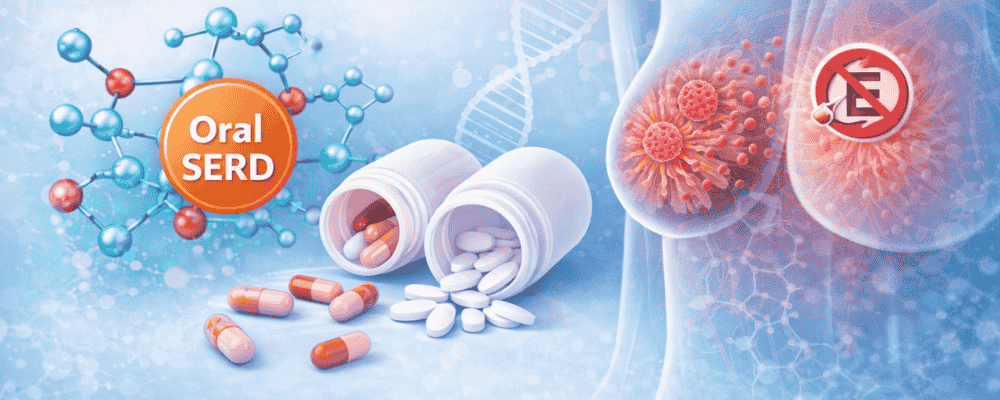
One of the most important additions in this shift is the rise of oral selective estrogen receptor degraders, also called oral SERDs.
Endocrine resistance means the cancer is no longer responding well to hormone-blocking treatment such as aromatase inhibitors or other endocrine options.
A common biological reason is that the tumor develops changes that keep estrogen receptor signaling active even when estrogen is suppressed.
A key example is an acquired ESR1 mutation, which can emerge during endocrine therapy and become a driver of resistance.
That is why ESR1 mutation testing has become more important for selecting the next endocrine strategy.
Traditional endocrine drugs often work by lowering estrogen levels or by blocking estrogen receptors. SERDs go one step further: they target the estrogen receptor for degradation, helping shut down signaling more completely.
Oral SERDs matter because they are easier to take than injectable options and are being developed to be more potent, especially for tumors with ESR1-driven resistance.
CDK4/6 inhibitors plus endocrine therapy became the standard first-line approach for many patients with HR positive, HER2-negative metastatic breast cancer.
When the disease progresses on that combination, the next step is increasingly guided by tumor biology, especially ESR1 status.
Elacestrant, an oral SERD, is FDA approved for postmenopausal women or adult men with ER-positive, HER2-negative, ESR1-mutated advanced or metastatic breast cancer after progression on at least one line of endocrine therapy.
This approval reflects the idea that if an ESR1 mutation is present, switching to an oral SERD can be a more targeted move than simply rotating among older endocrine options.
Imlunestrant is also FDA approved for ER-positive, HER2-negative, ESR1-mutated advanced or metastatic breast cancer after progression following at least one line of endocrine therapy.
A newer concept is early switching based on blood-based monitoring rather than waiting for radiographic progression.
SERENA-6 is a phase 3 study in which patients on first-line aromatase inhibitor plus CDK4/6 inhibitor receive regular ctDNA monitoring. If an ESR1 mutation is detected in blood, the endocrine drug can be switched to an investigational oral SERD while continuing the same CDK4/6 inhibitor, aiming to extend disease control.
Publicly reported results showed a meaningful improvement in progression-free survival with this early switch concept compared with continuing on the aromatase inhibitor.
What this means for patients: the care model is moving toward earlier detection of resistance and earlier adjustment, rather than waiting for the cancer to declare resistance on scans.
For many patients, the goal is longer control with fewer disruptions to daily life. Oral endocrine options can reduce clinic time and keep treatment simpler, but every drug still has side effects and tradeoffs.
The practical direction from expert discussions is:
Often at recurrence or progression, and increasingly in strategies that consider earlier blood-based detection of emerging resistance.
Yes. ESR1-mutated disease is a key setting in which an oral SERD may be a better-matched endocrine option than older approaches.
No. Oral SERDs are endocrine-targeted therapy, not chemotherapy.
Oral SERDs are becoming a major option after endocrine resistance in HR positive, HER2-negative breast cancer, especially when ESR1 mutations are involved.
The field is also moving toward proactive management using blood-based molecular monitoring to switch endocrine therapy earlier and potentially extend the benefit of first-line regimens.
Medical Review DisclosureThis content has been reviewed for medical accuracy. Always consult a qualified healthcare professional before making any medical
Medical Review DisclosureThis content has been reviewed for medical accuracy. Always consult a qualified healthcare professional before making any medical
Medical Review DisclosureThis content has been reviewed for medical accuracy. Always consult a qualified healthcare professional before making any medical
Our pharmacists can confirm availability, pricing and what your country requires for import.