
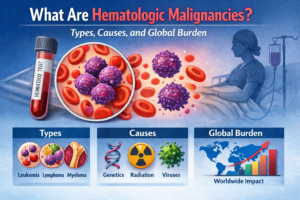
What Are Hematologic Malignancies? Types, Causes, and Global Burden
Medical Review DisclosureThis content has been reviewed for medical accuracy. Always consult a qualified healthcare professional before making any medical
Blood Cancer

Medical Review Disclosure
This content has been reviewed for medical accuracy. Always consult a qualified healthcare professional before making any medical decisions. [Last reviewed: 2026-06-16]
The realization that you or someone close to you needs a bone marrow transplant can be extremely daunting. It may not occur to some people that when we say “transplant,” we are referring to something that is far from surgery.
Rather, a bone marrow transplant, which is sometimes also referred to as a blood or stem cell transplant, is an innovative form of cellular treatment that is quite similar to a regular blood transfusion.
It is through the continuous innovations of top-notch research organizations such as the National Marrow Donor Program, the Fred Hutchinson Cancer Center, and the Mayo Clinic that bone marrow transplants have become highly predictable and curative procedures for patients suffering from life-threatening blood disorders.
This guide will take you through a detailed look at the whole procedure of BMT.
Bone marrow is the soft, spongy tissue found in the interior of your major bones, specifically in your hipbones, thigh bones, and sternum. Imagine your bone marrow as the body’s main blood factory.
Within the bone marrow are immature cells called hematopoietic stem cells. The hematopoietic stem cells are the templates for your blood; they continually duplicate themselves and develop into three essential parts:
Should a patient suffer from an illness that either damages, kills, or genetically alters the bone marrow, the body will be unable to make normal blood cells.
Bone marrow transplant surgery completely reboots the system by wiping out the damaged marrow and injecting fresh, functioning stem cells, thus creating new circulatory and immune systems.
The two specialists most likely to perform bone marrow transplants include the following:
It is essential to understand that bone marrow transplants can be classified according to how the healthy stem cells are obtained.
In addition, selecting the appropriate kind of bone marrow transplant is an extremely individualized procedure based on many factors such as your medical history.
1. Autologous Transplant (Self-Derived Cells): Autologous transplant involves utilizing your own cells as the donor cells. It is mainly used for treatment of aggressive conditions such as multiple myelomas or lymphomas that have not aggressively affected the bone marrow.
As your condition remains under control and in remission, doctors collect your healthy blood stem cells from your body using a special machine. After freezing the healthy blood stem cells, they are kept under secure storage. Later, after the conditioning treatment for eliminating any potential cancer cell present inside your body, the frozen cells are unfrozen and re-transplanted back into your body, which will rapidly restore your bone marrow function. There is no chance of any rejection due to the self-derived cells.
2. Allogeneic Transplant (Externally Derived Cells): In an allogeneic transplant procedure, healthy blood stem cells are derived from an external source. In cases of aggressive leukemia, your original blood stem cells become non-functional. Hence, in such cases, allogeneic transplantation becomes necessary. Due to the introduction of a foreign immune system into your body, your body should match that of your donor.
To determine a match, doctors utilize a specialized blood test called Human Leukocyte Antigen (HLA) typing. HLAs are proteins found on the surface of most cells in your body, acting as an implementation of a molecular “fingerprint” that tells your immune system which cells belong to you and which are foreign.
3. Haploidentical Transplantation (Half-Match): Previously, the lack of a perfect HLA match rendered an allogeneic transplant impossible. Now, however, sophisticated cell selection techniques make haploidentical transplantation possible. Haploclentic transplantation refers to a special type of allogeneic transplant whereby the donor is an exact half-matched donor, either a parent, child, or partially matched sibling. There are special drugs used after a transplant to increase its accessibility and success rate.
A bone marrow transplant is not an isolated event; it is a clinical journey divided into four distinct phases.
Phase 1: Pre-transplant Evaluation & Preparation
Prior to undergoing any treatments, you will have to go through an intense evaluation of your physiological and psychological condition.
Your transplant team will carefully assess your heart, lungs, liver, and kidneys to ensure that your body is ready for the transplant surgery.
During this phase, a surgeon will place a flexible and thin silicone tube called the central venous catheter (or central line) in your large veins in your upper chest area.
You will be able to carry this line for several months because it allows the medical team to give you chemotherapy, inject fluid, stem cells, and even withdraw blood samples without having to prick yourself each time.
Phase 2: The Conditioning Phase
Having passed the first part of the process, you proceed to the hospital for your conditioning phase. During this phase, you will be subjected to a regimen of high-dose chemotherapy and total body irradiation (TBI) for 3 to 7 days. This highly aggressive approach is needed for two important reasons:
Phase 3: The Stem Cell Infusion (Day Zero)
Your transplantation day is traditionally known as “Day Zero.” All the days before your procedure will have negative numbers (like Day -5 for your preparation phase), and any days after will have positive numbers as part of your recovery process.
On Day Zero, the transplanted healthy stem cells will be placed in a secure clinical bag and transferred directly to your hospital bed.
The procedure will appear very similar to a regular blood transfusion, taking between 30 minutes and several hours to complete, while you remain conscious and closely monitored by nurses for possible side effects, such as fever or chills.
Interestingly enough, the tiny stem cells contain natural homing chemicals. In your bloodstream, they will automatically move through your vessels, into bone marrow cavities, and occupy the vacated spaces prepared during your conditioning stage.
Step 4: Engraftment
Following the procedure, the next stage is to wait. The transplanted stem cells have to grow, adhere to the cavities in the bones, and start producing new amounts of red blood cells, white blood cells, and platelets. This process is called engraftment.
Engraftment may take 14 to 30 days after transplantation, depending on what type of procedure you have had and what donor you have received the stem cells from. At this point, your blood cells are at their lowest, and you become susceptible to many problems.
Bone marrow transplant requires very sophisticated facilities within hospitals, clean-air rooms, advanced lab processing, and many professionals from various areas such as hematologists, pharmacists, and specialty nurses.
This is why bone marrow transplant entails great costs.
When reviewing financial estimates, it is crucial to understand that the final cost is dictated primarily by the complexity of the transplant type:
Because a bone marrow transplant completely rebuilds your immune and circulatory architecture, it carries a unique profile of potential medical risks that require proactive surveillance.
One of the common problems of allogeneic transplantation is called graft versus host disease (GvHD). This is caused by the new immune cells (the “graft”) looking into your cells (the “host”) and treating them as a threat, initiating an attack on your body.
When you go through the conditioning process and up until engraftment time, you have very few white blood cells that help fight infections.
Even after undergoing engraftment, your immune system becomes naïve, just as that of an infant—meaning that it does not remember any viruses or vaccines received before.
You become vulnerable to any kinds of infection, which calls for antineoplastic drugs.
The severe chemotherapy involved in conditioning may lead to an inflammatory condition referred to as mucositis, which is characterized by painful ulcerations of the membranes lining the mouth, esophagus, and gastrointestinal tract.
Your kidneys and liver are also subjected to temporary stress, which your team tracks through daily blood tests for creatinine and liver enzymes.
Day 1 to Day 30: The In-Patient Isolation Phase
Day 30 to Day 100: The Outpatient Surveillance Window
Beyond Day 100: Long-Term Healing
However, stem cell infusion is a procedure that does not hurt at all. This process takes place when you are awake in your hospital bed.
Physical discomfort results from the conditioning part of the therapy process, where you may experience extreme exhaustion, nausea, as well as painful ulcers in your mouth. Pain management is achieved using intravenous drugs.
Thanks to international donor networks and medical advancements, a lack of a sibling match is no longer a barrier.
Doctors can easily look for an unrelated volunteer donor through global registries or proceed with a haploidentical (half-match) transplant using a parent or child.
Most patients can begin transitioning back to a desk job or light routine activities around 3 to 6 months post-transplant for an autologous procedure, and 6 to 12 months for an allogeneic transplant, provided their immune system has recovered adequately and blood counts remain stable.
Medical Review DisclosureThis content has been reviewed for medical accuracy. Always consult a qualified healthcare professional before making any medical
Our pharmacists can confirm availability, pricing and what your country requires for import.