

Prostate Cancer Screening: When Should Men Get Tested?
Medical Review DisclosureThis content has been reviewed for medical accuracy. Always consult a qualified healthcare professional before making any medical
Understanding Cancer

Medical Review Disclosure
This content has been reviewed for medical accuracy. Always consult a qualified healthcare professional before making any medical decisions. [Last reviewed: 2026-10-16]
Medical Disclaimer: The information provided in this article is for educational and informational purposes only. It is not intended to substitute for professional medical advice, diagnosis, or treatment. Always seek the advice of an oncologist or other qualified healthcare provider regarding a medical condition, biomarker testing, or treatment plan.
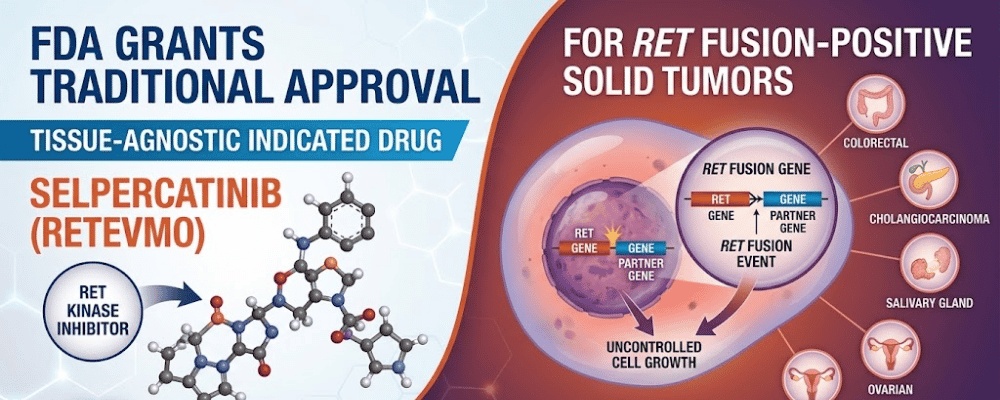
The U.S. Food and Drug Administration (FDA) has granted traditional (full) approval to selpercatinib (Retevmo) for adult and pediatric patients 2 years of age and older with locally advanced or metastatic RET gene fusion-positive solid tumors.
This regulatory milestone applies to patients whose cancer has progressed on or following prior systemic treatment, or who have no satisfactory alternative treatment options. The decision converts the accelerated approvals previously granted for adults (in 2022) and pediatric patients (in 2024) into a full, traditional approval, confirming selpercatinib’s clinical benefit across a broad spectrum of cancers.
The FDA’s decision was supported by robust efficacy and safety data from the multi-center, open-label Phase 1/2 LIBRETTO-001 trial (NCT03157128) in adult patients, supported by findings in pediatric patients from the Phase 1/2 LIBRETTO-121 trial (NCT03899792).
In a dedicated cohort of 75 evaluable patients with RET fusion-positive solid tumors (excluding non-small cell lung cancer [NSCLC] and thyroid cancer, which were evaluated in separate trial cohorts):
Overall Response Rate (ORR): 47% (95% CI: 35%–59%)
Median Duration of Response (DOR): 24.5 months (95% CI: 11.2–49.1)
Because selpercatinib is a tissue-agnostic targeted therapy, it works by targeting the specific RET genetic alteration rather than the organ where the cancer originated. Objective tumor shrinkage was confirmed across a wide variety of cancer types, including:
Pancreatic adenocarcinoma and neuroendocrine tumors
Colorectal and small intestine cancers
Cholangiocarcinoma (bile duct cancer)
Salivary gland cancer
Soft tissue sarcoma and skin carcinomas
Breast and ovarian cancers
Bronchial carcinoid tumors and cancers of unknown primary origin
In pediatric and young adult patients evaluated in the LIBRETTO-121 trial, confirmed responses were observed in patients with refractory RET fusion-positive solid tumors, including congenital infantile fibrosarcoma and spindle cell sarcoma.
Selpercatinib is an oral capsule/tablet administered twice daily. Dosing for adults and pediatric patients aged 12 years and older is determined by body weight:
| Body Weight | Recommended Oral Dosage |
| Less than 50 kg | 120 mg twice daily |
| 50 kg or greater | 160 mg twice daily |
Note: For pediatric patients aged 2 to under 12 years, dosing is calculated based on body surface area (BSA) as detailed in the official prescribing information.
While selpercatinib offers an effective oral targeted option, the official FDA label includes specific warnings and precautions that require regular monitoring by an oncology team:
Hepatotoxicity: Elevated liver enzymes (ALT/AST); blood tests are required before starting and periodically during treatment.
Hypertension: Blood pressure should be controlled before starting therapy and monitored regularly.
QT Interval Prolongation & Cardiac Events: Periodic ECGs and electrolyte checks are recommended.
Interstitial Lung Disease (ILD) / Pneumonitis: Patients should report any new or worsening respiratory symptoms (cough, shortness of breath) immediately.
Hemorrhagic Risk & Wound Healing: Therapy should be temporarily withheld before planned surgical procedures.
Additional Precautions: Hypothyroidism, hypersensitivity reactions, tumor lysis syndrome, embryo-fetal toxicity, and slipped capital femoral epiphysis in pediatric patients.
This traditional approval emphasizes the essential role of comprehensive genomic profiling (CGP) or Next-Generation Sequencing (NGS) in modern oncology.
Because RET gene fusions occur across many different solid tumor types, patients with advanced or refractory cancers should discuss biomarker testing with their oncologist to determine if their tumor harbors a RET fusion and if selpercatinib is a suitable treatment option.
U.S. Food and Drug Administration (FDA): FDA Grants Traditional Approval to Selpercatinib for Locally Advanced or Metastatic RET Fusion-Positive Solid Tumors
CancerNetwork: FDA Traditionally Approves Selpercatinib in RET+ Solid Tumors
ClinicalTrials.gov: Phase 1/2 Study of LOXO-292 (Selpercatinib) in Patients With Advanced Solid Tumors (LIBRETTO-001)
Medical Review DisclosureThis content has been reviewed for medical accuracy. Always consult a qualified healthcare professional before making any medical
Medical Review DisclosureThis content has been reviewed for medical accuracy. Always consult a qualified healthcare professional before making any medical
Medical Review DisclosureThis content has been reviewed for medical accuracy. Always consult a qualified healthcare professional before making any medical
Our pharmacists can confirm availability, pricing and what your country requires for import.