
Ruxolitinib Tablets Receive FDA Approval for Hematologic Malignancies
Medical Review DisclosureThis content has been reviewed for medical accuracy. Always consult a qualified healthcare professional before making any medical
Cancer Medicine

Medical Review Disclosure
This content has been reviewed for medical accuracy. Always consult a qualified healthcare professional before making any medical decisions. [Last reviewed: 2026-05-17]
n
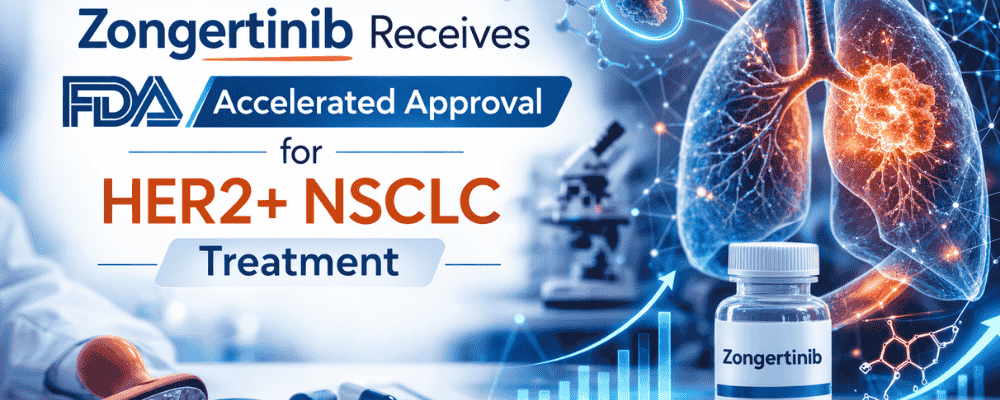
The U.S. Food and Drug Administration has approved zongertinib (brand name Hernexeos) for the treatment of adults with unresectable or metastatic nonsquamous non–small cell lung cancer harboring HER2 tyrosine kinase domain–activating mutations. The approval was granted under the FDA’s Commissioner’s National Priority Voucher pilot program, reflecting the agency’s effort to accelerate review of potentially practice-changing therapies.
Zongertinib had previously received accelerated approval in this indication in August 2025. The latest regulatory decision reinforces its role as a targeted therapy option in HER2-mutated NSCLC.
Non–small cell lung cancer accounts for approximately 85 percent of lung cancer cases. Within this group, a small but clinically significant subset of patients harbor activating mutations in the HER2 gene, particularly in the tyrosine kinase domain.
HER2 mutations drive tumor growth by promoting uncontrolled cell signaling. Historically, treatment options for HER2-mutant NSCLC have been limited, and outcomes have lagged behind those seen in other biomarker-defined lung cancer populations such as EGFR or ALK.
The approval of zongertinib represents another step forward in precision oncology, in which treatment is tailored to specific genetic alterations.
Zongertinib’s approval occurred under the FDA’s Commissioner’s National Priority Voucher program, a pilot initiative designed to fast-track therapies that may provide substantial benefit in areas of unmet need.
The supplemental new drug application was filed on January 13, 2026, and the FDA rendered its final decision just 44 days after filing. According to FDA Commissioner Marty Makary, MD, MPH, the program is intended to reduce idle review time while maintaining rigorous safety standards.
This rapid timeline highlights the agency’s commitment to expediting access to transformative cancer therapies.
The approval was supported by data from the phase 1b Beamion LUNG-1 trial (NCT04886804), which evaluated zongertinib in patients with treatment-naive advanced NSCLC harboring HER2 mutations.
The markedly higher response rate suggests meaningful antitumor activity compared with existing options. These findings were presented at the European Society for Medical Oncology 2025 Congress.
Such response rates are particularly important in advanced or metastatic settings, where treatment options are often limited and durable responses can significantly impact quality of life.
While zongertinib demonstrated strong efficacy, important safety considerations were noted.
Patients receiving zongertinib require careful monitoring, particularly for liver function and pulmonary symptoms. As with many targeted therapies, risk–benefit assessment remains central to treatment decisions.
The approval of zongertinib reinforces several key trends in oncology:
Oncologists should consider comprehensive genomic profiling in eligible patients to identify HER2 tyrosine kinase domain–activating mutations that may qualify them for targeted therapy.
For patients diagnosed with metastatic or unresectable nonsquamous NSCLC:
Patients should discuss biomarker testing and available targeted treatments with their oncology team.
Zongertinib’s FDA approval marks an important development in the treatment of HER2-mutated non–small cell lung cancer. Backed by strong response rates in the Beamion LUNG-1 trial and accelerated through the Commissioner’s National Priority Voucher program, this therapy represents progress in precision lung cancer care.
As molecular profiling continues to refine cancer treatment strategies, targeted agents like zongertinib are reshaping the therapeutic landscape for biomarker-defined populations.
Disclaimer: This article is for educational purposes only and does not constitute medical advice. Treatment decisions should be made in consultation with a qualified healthcare professional.
Medical Review DisclosureThis content has been reviewed for medical accuracy. Always consult a qualified healthcare professional before making any medical
Medical Review DisclosureThis content has been reviewed for medical accuracy. Always consult a qualified healthcare professional before making any medical
Medical Review DisclosureThis content has been reviewed for medical accuracy. Always consult a qualified healthcare professional before making any medical
Our pharmacists can confirm availability, pricing and what your country requires for import.