

Medical Review Disclosure
This content has been reviewed for medical accuracy. Always consult a qualified healthcare professional before making any medical decisions. [Last reviewed: 2026-02-10]
Understanding blood cancers and their impact on global health
Hematologic malignancies, commonly known as blood cancers, represent a diverse group of diseases that affect the blood, bone marrow, and lymphatic system. These cancers disrupt the normal production and function of blood cells, leading to serious health complications. Unlike solid tumors, which form masses within organs, hematologic malignancies involve abnormal cell growth throughout the circulatory and lymphatic systems.
Understanding these cancers is crucial, as they affect millions of people worldwide and continue to pose significant challenges to healthcare systems globally. This comprehensive guide will help you understand what hematologic malignancies are, their different types, underlying causes, and their impact on global health.
Understanding the Blood and Lymphatic System
To understand hematologic malignancies, it’s essential to first understand the normal function of blood and the lymphatic system:
The Blood System
Blood is composed of several key components, all produced primarily in the bone marrow:
- Red Blood Cells (Erythrocytes): Carry oxygen from the lungs to body tissues and carbon dioxide back to the lungs
- White Blood Cells (Leukocytes): Fight infection and disease as part of the immune system
- Lymphocytes (B cells, T cells, NK cells)
- Granulocytes (neutrophils, eosinophils, basophils)
- Monocytes
- Platelets (Thrombocytes): Help blood clot to stop bleeding
- Plasma: The liquid portion carrying nutrients, hormones, and proteins
The Bone Marrow
The bone marrow is the soft, spongy tissue inside bones where blood cell production (hematopoiesis) occurs. Hematopoietic stem cells in the bone marrow give rise to all blood cell types through a carefully regulated process.
The Lymphatic System
This network includes:
- Lymph nodes (filters for harmful substances)
- Lymphatic vessels (transport lymph fluid)
- Spleen (filters blood, stores blood cells)
- Thymus (where T cells mature)
- Tonsils and adenoids
What Are Hematologic Malignancies?
Hematologic malignancies arise when blood cells or their precursors undergo malignant transformation, developing genetic mutations that drive uncontrolled growth and division. These abnormal cells:
- Proliferate excessively, crowding out normal blood cells
- Don’t mature properly and can’t perform normal functions
- Don’t die when they should (evade programmed cell death)
- May spread to other parts of the body
- Weaken the immune system and disrupt normal blood function
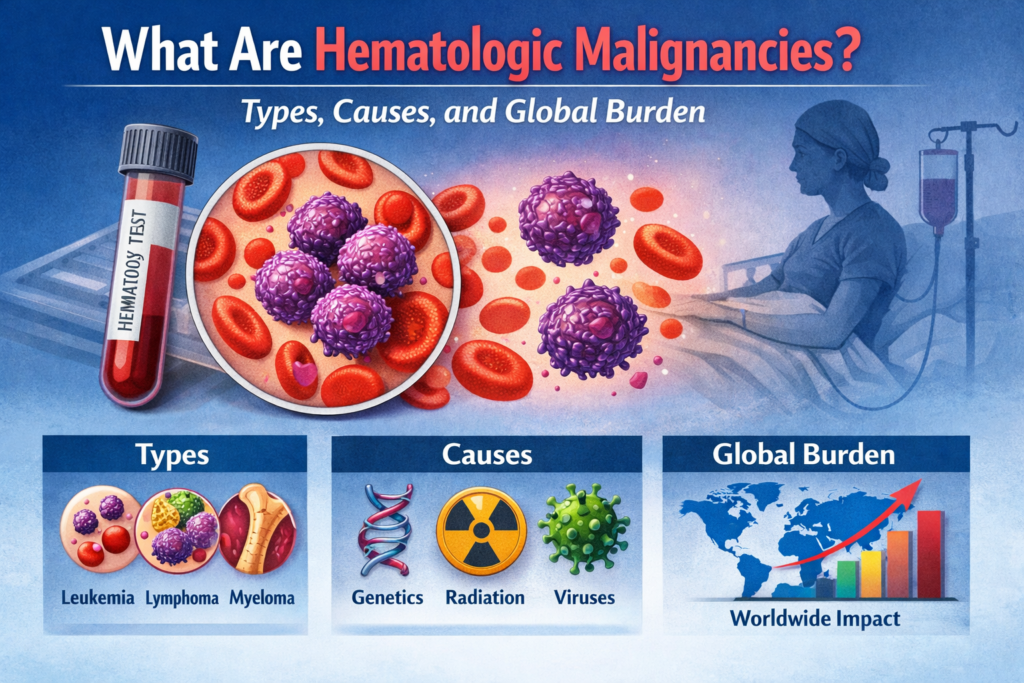
The three main categories of hematologic malignancies are leukemia, lymphoma, and myeloma, each with multiple subtypes.
Types of Hematologic Malignancies
1. Leukemia
Leukemia is a cancer of the blood-forming tissues, including bone marrow and the lymphatic system. It leads to the production of large numbers of abnormal white blood cells.
Classification: Leukemias are classified based on two factors:
- Speed of progression: Acute (fast-growing) or Chronic (slow-growing)
- Cell type affected: Lymphocytic/Lymphoblastic or Myeloid/Myelogenous
Main Types of Leukemia:
Acute Lymphoblastic Leukemia (ALL)
- Most common childhood cancer (peak age 2-5 years)
- Affects lymphoid cells (precursors to lymphocytes)
- Rapidly progressive without treatment
- Excellent cure rates in children (>90%), lower in adults
- Symptoms: Fatigue, fever, easy bruising, bone pain, swollen lymph nodes
Acute Myeloid Leukemia (AML)
- Most common acute leukemia in adults
- Affects myeloid cells (precursors to red blood cells, platelets, and some white blood cells)
- Aggressive and requires immediate treatment
- Average age at diagnosis: 68 years
- Five-year survival rate varies widely by age and subtype (25-70%)
Chronic Lymphocytic Leukemia (CLL)
- The most common leukemia in Western countries
- Typically affects older adults (median age 70)
- Slow progression; many patients live for years without treatment
- Often discovered incidentally during routine blood tests
- Not curable but highly manageable with treatment
Chronic Myeloid Leukemia (CML)
- Characterized by the Philadelphia chromosome (BCR-ABL fusion gene)
- Typically affects adults (median age 64)
- Three phases: chronic (slow), accelerated, and blast crisis (acute)
- Revolutionized by targeted therapy (tyrosine kinase inhibitors)
- Near-normal life expectancy with modern treatment
2. Lymphoma
Lymphoma is a cancer of the lymphatic system, affecting lymphocytes (a type of white blood cell). Abnormal lymphocytes accumulate in lymph nodes and other lymphoid tissues.
| Type | Hodgkin Lymphoma (HL) | Non-Hodgkin Lymphoma (NHL) |
|---|---|---|
| Frequency | About 10% of lymphomas | About 90% of lymphomas |
| Distinctive Feature | Presence of Reed-Sternberg cells | Absence of Reed-Sternberg cells |
| Subtypes | 5 main subtypes | Over 60 subtypes |
| Age Distribution | Bimodal: peaks in 20s and 50s | Increases with age; median age 67 |
| Spread Pattern | Predictably, spreads to adjacent lymph nodes | Unpredictable, can skip lymph nodes |
| Cure Rate | Very high (>80-90% in early stages) | Varies widely by subtype (20-90%) |
Common NHL Subtypes:
- Diffuse Large B-Cell Lymphoma (DLBCL): Most common NHL, aggressive but often curable
- Follicular Lymphoma: Slow-growing, often manageable for years
- Mantle Cell Lymphoma: Aggressive, requires intensive treatment
- Burkitt Lymphoma: Very aggressive, requires immediate treatment
- Marginal Zone Lymphoma: Slow-growing, often associated with infections
- T-Cell Lymphomas: Various subtypes affecting T lymphocytes
3. Multiple Myeloma
Multiple myeloma is a cancer of plasma cells—specialized B lymphocytes that produce antibodies. Malignant plasma cells accumulate in bone marrow and produce abnormal proteins.
Key Characteristics:
- Second most common blood cancer (after NHL)
- Median age at diagnosis: 69 years; rare under age 40
- Affects bone marrow, bones, kidneys, and the immune system
- Not curable but increasingly treatable with modern therapies
- Median survival has doubled in the past two decades
Common Complications:
- Bone disease: Lesions, fractures, pain
- Kidney damage: From abnormal proteins
- Anemia: Crowding out of normal blood cells
- Hypercalcemia: Elevated calcium from bone breakdown
- Infections: Weakened immune system
4. Myelodysplastic Syndromes (MDS)
MDS is a group of disorders in which the bone marrow doesn’t produce enough healthy blood cells. While technically not cancer initially, MDS can progress to acute myeloid leukemia in about 30% of cases.
- More common in older adults (median age 70+)
- Classified into risk groups based on the likelihood of progression
- Treatment ranges from supportive care to stem cell transplantation
- Often secondary to chemotherapy or radiation exposure
5. Myeloproliferative Neoplasms (MPNs)
MPNs are chronic blood cancers where the bone marrow produces too many blood cells:
- Polycythemia Vera: Excess red blood cells
- Essential Thrombocythemia: Excess platelets
- Primary Myelofibrosis: Scarring of bone marrow
Causes and Risk Factors
The development of hematologic malignancies is complex and multifactorial. Understanding risk factors can help with prevention and early detection:
Genetic Factors
Inherited Genetic Conditions:
- Down Syndrome: 10-20 times higher risk of ALL and AML
- Fanconi Anemia: Inherited bone marrow failure, high leukemia risk
- Li-Fraumeni Syndrome: Increased cancer risk, including blood cancers
- Familial Platelet Disorder: Predisposition to AML
- BRCA2 Mutations: Slight increase in leukemia risk
Acquired Genetic Changes:
- Most hematologic malignancies result from acquired (not inherited) mutations
- Specific chromosomal abnormalities (Philadelphia chromosome in CML)
- Gene mutations (FLT3, NPM1, CEBPA in AML)
- Epigenetic changes affecting gene expression
Environmental and Lifestyle Factors
Radiation Exposure:
- High-dose radiation (atomic bomb survivors, nuclear accidents)
- Therapeutic radiation for other cancers
- Repeated medical imaging (controversial, likely minimal risk)
Chemical Exposures:
- Benzene: Found in cigarette smoke, petroleum products; linked to AML and MDS
- Chemotherapy agents: Alkylating agents and topoisomerase II inhibitors
- Pesticides: Some studies show associations with NHL and leukemia
- Industrial chemicals: Solvents, dyes, formaldehyde
Smoking:
- Increases risk of AML by 30-40%
- Associated with poorer outcomes in multiple myeloma
- Contains benzene and other carcinogens
Infectious Agents
Certain infections are associated with specific blood cancers:
- Epstein-Barr Virus (EBV): Linked to Burkitt lymphoma, Hodgkin lymphoma
- Human T-Cell Leukemia Virus (HTLV-1): Causes adult T-cell leukemia/lymphoma
- Hepatitis C Virus (HCV): Associated with NHL and chronic lymphocytic leukemia
- HIV: Increases risk of aggressive lymphomas
- Helicobacter pylori: Linked to gastric MALT lymphoma
Immune System Disorders
- Autoimmune diseases: Rheumatoid arthritis, lupus increase lymphoma risk
- Immunosuppressive therapy: For organ transplants or autoimmune conditions
- Primary immunodeficiency disorders: Inherited immune system defects
Age and Demographics
- Age: Most hematologic malignancies increase with age; exceptions include ALL and Hodgkin lymphoma
- Gender: Males have higher incidence rates for most blood cancers
- Ethnicity: CLL is more common in Caucasians; multiple myeloma is twice as common in African Americans
Global Burden of Hematologic Malignancies
Hematologic malignancies represent a significant global health challenge, affecting populations worldwide with varying incidence and mortality rates across different regions.
1.24 Million
New cases of hematologic malignancies are diagnosed each year globally
720,000+
Deaths from blood cancers occur annually worldwide
Incidence by Cancer Type
| Cancer Type | Global Annual Cases | Percentage of All Cancers |
|---|---|---|
| Non-Hodgkin Lymphoma | ~544,000 | 2.8% |
| Leukemia (all types) | ~474,000 | 2.5% |
| Multiple Myeloma | ~176,000 | 0.9% |
| Hodgkin Lymphoma | ~83,000 | 0.4% |
| Total Hematologic | ~1,240,000 | ~6.5% |
Geographic Variations
The incidence of hematologic malignancies varies significantly across regions:
High Incidence Regions:
- North America and Europe: Highest rates of CLL, Hodgkin lymphoma, and multiple myeloma
- Australia/New Zealand: High NHL incidence
- Developed countries: Generally higher rates, possibly due to better detection and aging populations
Regional Variations:
- Asia and Africa: Lower overall rates but specific types more common (e.g., HTLV-1 related leukemia in Japan and Caribbean)
- Sub-Saharan Africa: Higher rates of Burkitt lymphoma, especially in children (associated with EBV and malaria)
- Middle East: Varying rates with increasing incidence in urbanized areas
- Latin America: Intermediate rates with country-specific variations
Economic Impact
The burden extends beyond health outcomes to high economic costs:
- Direct medical costs: Treatment of hematologic malignancies is expensive, particularly newer targeted therapies and immunotherapies
- Indirect costs: Lost productivity, caregiver burden, disability
- Healthcare system strain: Specialized care requirements, bone marrow transplant facilities
- Developing nations: Limited access to expensive treatments creates disparities
Treatment Cost Examples (U.S.):
- CAR T-cell therapy: $373,000 – $475,000 per treatment
- Novel agents for multiple myeloma: $150,000+ per year
- Bone marrow transplant: $300,000 – $800,000
- Chronic therapies: $100,000+ annually
Survival Trends
Despite challenges, survival rates have improved significantly:
5-Year Relative Survival Rates (U.S., 2013-2019):
- Hodgkin Lymphoma: 89%
- Chronic Lymphocytic Leukemia: 88%
- Non-Hodgkin Lymphoma: 74%
- Multiple Myeloma: 58%
- Chronic Myeloid Leukemia: 72%
- Acute Lymphoblastic Leukemia: 71% (children), 42% (adults)
- Acute Myeloid Leukemia: 30%
Factors Contributing to Improved Survival:
- Targeted therapies (tyrosine kinase inhibitors, monoclonal antibodies)
- Immunotherapies (CAR T-cell therapy, checkpoint inhibitors)
- Improved supportive care and infection management
- Refined risk stratification and personalized treatment
- Better stem cell transplantation techniques
- Earlier detection through improved diagnostics
Disparities in Care
⚠️ Healthcare Inequalities:
- Access to treatment: Significant gaps between high-income and low-income countries
- Diagnostic capabilities: Limited access to advanced testing in developing regions
- Clinical trials: Majority conducted in developed nations, limiting global representation
- Socioeconomic factors: Lower income is associated with worse outcomes even in developed countries
- Rural vs. urban: Treatment center proximity affects care quality and survival
Current Challenges and Future Directions
Ongoing Challenges
- Treatment resistance: Some cancers develop resistance to therapies
- Relapse rates: Many patients experience disease recurrence
- Treatment toxicity: Balancing efficacy with quality of life
- Access and affordability: High costs limit global access to novel therapies
- Late effects: Long-term complications in survivors
Emerging Advances
Promising Developments:
- CAR T-cell therapy: Genetically engineered immune cells showing remarkable responses
- Bispecific antibodies: Engaging multiple targets simultaneously
- Antibody-drug conjugates: Targeted delivery of chemotherapy
- Epigenetic therapies: Targeting gene expression changes
- Minimal residual disease monitoring: Ultra-sensitive detection of remaining cancer cells
- Artificial intelligence: Improving diagnosis, prognosis, and treatment selection
- Precision medicine: Genomic profiling to guide treatment choices
- Venetoclax combinations: New options for older AML patients
Research Priorities
- Understanding mechanisms of resistance
- Developing curative therapies for more subtypes
- Reducing treatment toxicity and improving quality of life
- Expanding access to novel therapies globally
- Identifying biomarkers for early detection
- Creating more affordable treatment options
Prevention and Risk Reduction
While many risk factors cannot be controlled, some strategies may reduce risk:
Modifiable Risk Factors:
- Quit smoking: Reduces AML and other cancer risks
- Limit chemical exposure: Use protective equipment when working with benzene or pesticides
- Maintain a healthy weight: Obesity is linked to increased lymphoma risk
- Infection prevention: Vaccination, safe practices to avoid hepatitis and HIV
- Occupational safety: Follow guidelines for radiation and chemical exposure
When to See a Doctor
Warning Signs Requiring Medical Attention:
- Unexplained, persistent fatigue or weakness
- Frequent infections or fever
- Easy bruising or bleeding
- Swollen, painless lymph nodes (neck, armpit, groin)
- Unexplained weight loss (>10% body weight in 6 months)
- Night sweats (drenching, requiring clothing/sheet changes)
- Bone pain or fractures without injury
- Shortness of breath or chest pain
- Abdominal fullness or swelling
- Frequent nosebleeds or bleeding gums
- Pale skin or signs of anemia
While these symptoms can have many causes, persistent or worsening symptoms warrant medical evaluation. Early detection often improves treatment outcomes.
Conclusion
Hematologic malignancies represent a diverse and complex group of cancers affecting millions worldwide. While they pose significant health and economic burdens globally, remarkable progress has been made in understanding their biology and developing effective treatments. Survival rates have improved dramatically over the past few decades, particularly for certain types like Hodgkin lymphoma and chronic myeloid leukemia.
The field continues to evolve rapidly, with novel immunotherapies, targeted treatments, and precision medicine approaches offering promise for improved outcomes. However, significant challenges remain, including treatment access disparities, drug resistance, and the need for curative therapies for aggressive subtypes.
Understanding risk factors, recognizing warning signs, and seeking prompt medical attention when symptoms arise are crucial steps in combating blood cancers. As research advances and global healthcare systems work to improve access to cutting-edge treatments, the future holds promise for continued improvements in the prevention, detection, and treatment of hematologic malignancies.
Medical Disclaimer:
This article is for informational purposes only and should not be considered medical advice. Hematologic malignancies are complex diseases requiring specialized medical care. If you have concerns about symptoms or risk factors, please consult with a qualified hematologist or oncologist. Diagnosis and treatment should always be conducted by healthcare professionals. Treatment decisions should be made in consultation with your medical team based on your specific circumstances, medical history, and current health status.
Expert Hematology Care Through Medsmonk
Medsmonk connects patients with world-renowned hematology-oncology centers and specialists for comprehensive evaluation, advanced diagnostics, and cutting-edge treatment of blood cancers. Our medical tourism services provide access to the latest therapies, clinical trials, and personalized care plans.
Contact Medsmonk to explore your treatment options and connect with leading experts in hematologic malignancies.
Resources
-
Global Cancer Observatory (IARC/WHO) – Non-Hodgkin lymphoma fact sheet: Click here
-
Global Cancer Observatory (IARC/WHO) – Multiple myeloma fact sheet: Click here
-
NCI SEER – Cancer Stat Facts (survival statistics): Click here
-
WHO – HTLV-1 fact sheet (ATL risk): Click here